Tuesday, 26 April 2011

Confusion and suspicion

CCTV catches the incident in Tigre
The confusion and possibility for misfortune that can come from living in a distrusting, mistrusting and genuinely suspicious of ‘just about anybody you don’t know’ society were demonstrated with perfect clarity yesterday in Tigre, a somewhat more affluent town to the north of the capital.

High crime, general insecurity and the constant fear evoking media coverage that accompanies it all in Argentina, makes partaking in a private transaction of any sort something to be chary about. So when a Buenos Aires resident of the Dock Sur neighbourhood made his way to Tigre to buy a second-hand car, he was very much on guard and on the lookout for any fishy behaviour which could see him heading home by public transport, without the desired vehicle or the cash he was going to use to buy it.

Monday, 25 April 2011

El Truco

A weekend game of truco

'Envido.'
'Quiero.'
'31.'
'Son buenas.'
'Truco.'
'Quiero re truco.'
'Quiero vale cuatro.'
'Quiero.'
'Hijo de puta.'

Truco, Argentina’s card game of choice. Just watching can be exhausting; actually playing, an on your toes, get stuck in fully blown, loud, deceitful, slap you on your back Argentine experience.

Truco (Trick) is just that. A game filled with trickery, lies, gamesmanship, tactics, skill and like with any other card game, a little bit of old lady luck.

It is played with what are known in Argentina as Cartas Españolas (Spanish cards). The deck is made up of fifty cards numbered one to twelve. There a four suits, called palos. Basto (clubs), Oro (gold), Espadas (swords) and Copas (cups). For truco the eights and nines are removed from the deck.

The game can be played one on one but generally the real version is played in pairs, two on two; or in extreme situations with six players. 

Spanish Cards used for Truco
The object: to be the first to get thirty points. The first fifteen points are known as malas (bad) and the second half buenas (good). Points are obtained by winning during the two parts of each round, the envido and the truco.

The round starts with three cards dealt to each player. If you’re playing with a partner then some face signals will be made to let him know what cards you have. Bravado, lies and perhaps some truths are shouted around the table as the round gets underway.

Reading this without ever having encountered the game will no doubt be a tad confusing but the basic idea for the envido is to have the highest total, or to make your opponents think you do.

If you have two cards of the same suit, then you have something to play. You take the total of your two cards and add that to twenty. For example, if you have the seven of Gold and the six of Gold then you have thirty-three (the highest possible as 10s, 11s and 12s count as zero). If you’re left with nothing, then your only chance of winning is to out lie your opponents in a macho effort to convince them you have more than they do.

La mano (the hand) is the person to the right of the dealer and he has first chance to bet. If he chooses to he will shout envido (as soon as that word is mentioned at any moment then the bet is made). During the betting, players will crack jokes and employ other means of distraction to try to put their opponent off; be it to dissuade his betting or to to lull him into a false sense of security.

The betting responses to a call of envido are:
Quiero (I want) - the round is worth two points. 
Real envido - ups the stakes to three points.
Envido - means there are four points up for grabs.
Falta envido - you win whatever your opponent needs to complete his malas (first fifteen) or his buenas. 
No quiero - You bow out and automatically lose points.

After concluding who has the highest (without showing your cards for now), the second part of the round commences; the truco.

In the truco it is a fight to see who has the best cards. The cards are ranked in order of value. 

The One of Swords
The One of Clubs
The Seven of Swords
The Seven of Gold
The 3s
The 2s
The One of Cups & the One of Gold
Then from the 12s down to the 4s

Each player in turn throws down a card face up and the highest card kills the other cards and wins. The idea is to win two out of the three throws to take the points for truco. Throughout this part of the game more betting is going on in a similar way to that of the envido. Calling truco sets up the betting, and you can up it all by shouting re truco and then quiero vale cuatro (I want it’s worth four). 

If envido was played for, then knowing the total of your opponent gives you some idea what cards he has; but throughout the betting more lies and gamesmanship go on as you communicate with your partner as to the order in which you want to throw your cards or you use one of the many sneaky little tricks available to win. And remember, if at the end of the round no one has seen your cards and you won the envido, then be sure to show your total, or all the points you should have got will go to the other side the moment your cards are back in the pack.

A truco scorecard
If it all makes absolutely no sense whatsoever here, then rest assured it makes even less sense the first time you see a game played.

But when in Argentina, if you learn the value of the cards, the lip-licking and eyebrow raising face signals, then you can sit down around an empty crate of beer with a plank of wood on the top in a neighbourhood anywhere in the country, with one, three or five compañeros; and with some hard practice to get used to the pace, the jargon and the loud and jocular atmosphere of it all, you'll start to get the hang of it. And though you'll probably lose a few pesos as you get going, somewhere down the line with an afternoon's game of truco you might just end up winning a few bottles of Quilmes as you relish in the enjoyment of a truly great card game.
 

Thursday, 7 April 2011

The South Atlantic

The islands out there in the South Atlantic have been in the headlines rather more frequently as of late. Of course the subject is one that never really goes away in Argentina but political cynicism suggests that the government’s choosing to harp on about it right now might have something to do with the up-coming national elections in October.

Cristina Fernández de Kirchner definitely portrays herself as a president who is capable of ‘getting back what is rightfully Argentine’ and her publicly solid stance will no doubt secure her some extra votes come Election day. And it is clear that the more time she spends rallying the people with patriotic promises, the less time she spends addressing the real problems her government ought to be facing up to; potential vote losing topics like increasing inflation and troubling insecurity.

This 2 April, a national holiday in Argentina to commemorate the War Fallen and Veterans of the 1982 military conflict, not only saw the standard protests outside the British Embassy in Buenos Aires and parades throughout the country, but also various political announcements.

After screaming to a crowd in Rio Gallegos that the South Atlantic Islands “will be forever Argentine and this government will never yield our claim,” President Kirchner went on to say that “Argentina will continue to seek to resolve the issue in abidance with the UN,” stating that her country “only participates in peace missions,” while the UK sorts out its conflicts by “dropping bombs on Iraq, Afghanistan, Libya.”

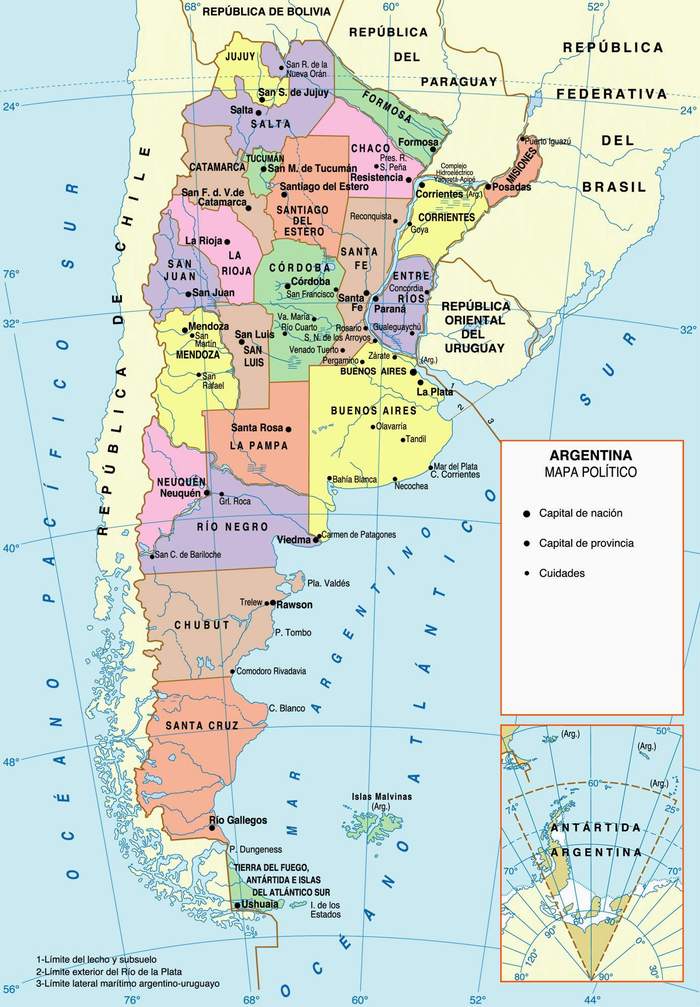
Argentine map of the Islands
Of course the arguments about who is abiding by the UN and whether the Islands should remain British or become Argentine have been going on for years with both sides delving into the history books to defend their claims, while accusing one another of improper or counter-productive behaviour.

A recent exchange of articles has taken place between London authors Peter Pepper and Graham Pascoe, and Andrés Cisneros, Argentina’s Deputy Foreign Minister during the 1990s Menem government.

In their first article ‘Unilateral Facts’ Pepper and Pascoe discuss Argentina’s recent accusations that the UK is acting ‘unilaterally’ and is ‘in breach of UN Resolution 31/49.’

The UN Resolution, which was agreed in December 1976, states that ‘each side should refrain from taking decisions that would imply introducing unilateral modifications.’ Pepper and Pascoe write that any talk about the Resolution post the 1982 War is absurd and suggest that the Argentine government is acting ludicrously and hypocritically in doing so now.

Cisneros responds in The Buenos Aires Herald with his article, ‘Unilateral Facts Indeed’ by emphasizing that the debate should go back a lot further than the UN Resolution and 1982 War and take into consideration the 19th Century ‘when London abused force by invading the islands and threatening with a display of weaponry all the Argentine inhabitants,’ - a response which prompted Pepper to argue about what is the ‘real history’ of the islands in ‘Unilateral Facts II’. All articles are very much worth the read.

The fact is most Argentines are firm in their belief that the UK is illegally occupying Argentine territory – and this popular viewpoint is as open to exploitation today as it was during the 1982 invasion. (NB ‘invasion’ is not a word Argentines will employ with respect to the incident citing the example that if someone was squatting in your property, you wouldn’t be labelled an invader if you went there to kick them out). 

And with the recent successful offshore oil explorations in South Atlantic waters, coupled with the October elections, the subject of the Islands' sovereignty is again being raised by the Argentine government.

This week the Argentine ambassador to the UN, Jorge Argüello has given a conference with the launch of 'It takes two to Tango.' Its idea is the promotion of a world-wide discussion on the whole issue.

The cenotaph at Plaza San Martín
And the announcement was made that the country is set to change its protocol for visiting officials by obligating them to pay homage at the cenotaph in Buenos Aires which lists the names of the 1982 War’s fallen soldiers.

Cristina Kirchner also announced that at as of 2012 a letter sent from the Islands by volunteer soldier Julio Cao will be read to all children in every school in Argentina. Shortly after joining the Military Junta’s campaign, Cao, a primary school teacher, sent the letter to his pupils to express his feelings about defending ‘the Argentine flag.’

Whether you believe these acts are pure politics or true patriotic gestures, the fact is the issue is not likely to go away soon but while the UK and Argentina quibble about the future, the Islands’ residents will continue to get on with the task of living.

“We are happy with the status quo, and do not like being told by others what to do,” said the Islands’ Legislative Assembly Member Emma Edwards during a UN seminar last year. “We are currently not ready for independence, but we do express our right of self-determination with almost all of the people on the Islands wishing to remain and enjoy our British Overseas Territory status.”


Wednesday, 30 March 2011

Argentine university honours Venezuela's Chavez


Venezuelan President Hugo Chavez was honoured in Argentina this week with a freedom of press award in recognition of “his unquestionable and authentic commitment to support the freedom of peoples.”

The University of La Plata presented Chavez with the prestigious Rodolfo Walsh Journalism award to pay tribute to the Venezuelan leader’s efforts "to support popular communication by breaking up media monopolies in Latin America."

Claudio Gomez, a journalism professor at the Universidad Nacional de La Plata said that the faculty’s decision to honour Chavez with the award “does not mean that the university agrees with certain measures his government has taken against critical mass media but it wishes to recognize for example his creation of the Telesur Channel.”

Created in 2005, Telesur is a state funded alternative to the continent's private television stations and covers Latin American and international news. It is considered to be an alternative voice to the massive privately owned media conglomerates, which Chavez highlights ‘seek to control the people.’

“One must fight the media dictatorship. The dominant classes always manipulate the communications media and trick the people through powerful psychological campaigns,” he said during his two hour acceptance speech at the university.

“There is more freedom of expression and press in Venezuela today than during any time in our history,” he claimed, stating that he was proud to receive the award even though “some people say the dictator Chavez doesn’t deserve it.”

The journalism award is named after the journalist Rodolfo Walsh who, after co-founding Cuba’s state-run news agency Prensa Latina, was killed during the Dirty War in 1977 when the military dictatorship in Argentina went about eradicating the country of dissidents.

Those opposed to the university’s choice stressed Chavez’s track record with the media. “He has closed more than 30 radio stations and six television channels,” pointed out Buenos Aires province congressman Jorge Macri. While Silvana Giudici, the head of the Argentine parliament’s commission for freedom of expression, said it was “inconceivable” and “a contradiction” to issue the award to the Venezuelan President.

But the university stuck by its decision to honour Chavez for “his commitment to defending the liberty of the people, consolidating Latin American unity, and defending human rights, truth, and democratic values.”

“You head a profound process of emancipation in Latin America,” said the university’s Dean Florencia Saintout, who announced that a new category of the Walsh award had been created for Latin American leaders committed to giving a voice to the people who are least heard from; adding that she hoped for an open debate about Chavez’s ideas. 


Monday, 28 March 2011

La fiesta de quince - The 15th birthday party


For girls in the US it’s a sweet sixteen party, for those in the UK it’s probably two or three bottles of Vodka Absolut while larging it about town on the night of their eighteenth. Every part of the world has its own customs to mark that first moment of adulthood. In Argentina, like in many other Latin America countries, the age at which young girls celebrate their coming of age is fifteen; and they do it with style.

La fiesta de quince, the fifteenth birthday party for girls, is more than just a big deal in Argentina. It’s the moment every little girl has waited for since she was messing around with her Barbie doll and playing dress-up (or messing around with her Action Man and playing footy; to be politically correct).

Although a trip abroad is gaining popularity, more often than not to that fun-packed destination favoured by middle class Argentines – Florida’s Disneyworld, traditionally the birthday is celebrated with an almighty party, largely reminiscent of a wedding.

And it's a party that parents have planned for their daughter since the day she was born; the crowning moment when their baby girl makes the transition to womenhood. They've scrimped and saved, booked the venue, arranged the music and entertainment, and food, and drink, and the guest list, and the flowers, maybe a mariachi band, the cake, the limousine, the photographer, the cameraman, the decorations; it’s all ready to go, one night to celebrate their daughter’s fifteenth with a bang.

In general, it goes something like this.

The hundreds of invited guests, both teenage friends of the birthday girl and adult family and acquaintances, get to the salon ahead of time where the waiting staff accommodates them all while they anticipate the arrival. The dress code is formal and the salon is decked out with all sorts of bright and colourful decorations.  

As the tension builds, tongues are moistened with free flowing beer and soft drinks until the announcement is made; she is here. It is time for the grand entrance.

Guests red rose-up and line the hall to form an aisle, while the immediate family waits at the end of the line to greet their daughter and sister.

The music starts. A song chosen by the girl - maybe a little Britney or Cristina. And then the doors open. She appears on the arm of her father; the duo's smiles lit up by spotlights.

She’s nervous, apprehensive, perhaps visibly overwhelmed; but she’s beautiful. Her hair and make-up are exquisite, and the dress; the all important dress is glamorous, long and glamorous. Gasps and mutterings can be heard in the crowd ‘Que hermosa que está, es una princesita!

By the time her father has walked her down the aisle to present her to her family, she is holding all the red roses and is breathing normally again. She is plastered with kisses from every direction as she soaks up the applause. She is fifteen and this is her moment.

Papa retakes her hand and accompanies her to the floor for the first dance with his grown-up daughter. The Waltz. Eyes are directed to the couple as all the men queue up to take a turn spinning the birthday girl round in celebration.

And when the Waltz is concluded, the food is served. Adults drink and chat, family members reminisce, spotty teenagers joke around and seek out a sneaky beer, while little toddlers run all over the place as they play with their new friends.

After a couple of hours of energetic and rhythmic dancing in a typically natural and Latin manner (the way Argentines are so coordinated on the dancefloor is frankly not reminiscent of everyday society and really beggars belief), the ceremony of the fifteen candles takes place.

This is the moment when the birthday girl chooses the fifteen people she sees as having been the most important in her life thus far. She makes a speech about each and presents them all with a candle.

Finally the cake is cut and scoffed, and the real partying begins. Lights dim, cumbia music starts back-up and it’s proper dancing time until the night finally draws to a conclusion somewhere around 6am.

A good old bit of fun-til-the-sun-comes-up has been had by all, and for now the parents can relax until number two daughter approaches that all important age and la fiesta de quince, which in Argentina, marks the end of childhood and the beginning of womanhood.  

Friday, 4 March 2011

Stolen babies and Argentina's Dirty War

Jorge Videla, left and Reinaldo Bignone
Two former dictators of Argentina, along with six other ex-military figures have gone on trial this week accused of stealing up to 500 new born babies from political prisoners during the country’s violent military rule.

Jorge Videla, who ruled Argentina between 1976 and 1981 and Reinaldo Bignone, the county’s leader for the last year of military dictatorship before democracy’s return in 1983, appeared in court last Monday where charges covering 34 individual cases were read to them.

During the trial, officials for the prosecution will present evidence from around 370 people to outline the viciously cruel acts carried out by the regime during Argentina’s Dirty War – a period that Federal Prosecutor Federico Delgado called ‘one of the darkest episodes in Argentine history.’

Activist groups like La Asociación Abuelas de Plaza de Mayo (The Grandmothers of the Plaza de Mayo) say that the mothers of the children stolen were imprisoned in torture houses, where shortly after giving birth while blindfolded, they were executed and usually dropped from airplanes over the Atlantic or the River Plate. The babies were then given to families sympathetic to the military regime. 

The 85-year-old Jorge Videla, who is already serving a life sentence for crimes against humanity after the amnesty he’d previously received was overturned in December last year, is widely regarded as the mastermind of Argentina’s Dirty War, which lasted seven brutal years from 1976 to 1983.

Videla's real rise to power came in 1975 when pressured by senior military figures and the wealthy rightist elite, President Isabel Perón appointed him Commander in Chief of the Argentine army after her government became increasingly threatened by a left-wing uprising. Videla immediately promoted the use of death squads, asserting that ‘as many as necessary must die in Argentina so that the country will again be secure.’ With his mitts firmly wrapped around power, a junta led a coup one year later.

Videla in the 1970s
The new regime, with Videla at its head, took on the task of ‘stabilising’ society. 

It labelled itself ‘National Reorganisation Process’, and went about eradicating the country of so-called subversives, principally left-wing activists, trade unionists, Peronists, students, journalists and Marxists - a campaign that was known as Operation Condor.

Despite history, Videla still claims today that Argentine society at the time of his reign demanded strength to counter Marxist revolution.

The USA, a country petrified of communism, agreed, and so the Argentine military junta was allowed to carry on its brutal rule without an ounce of international objection from the north. In fact, documents obtained under the Freedom of Information act show that many high ranking US officials, including Secretary of State Henry Kissinger, gave their full support to the murderous regime and its Dirty War, and the US congress granted more than $US100,000,000 to assist the military dictatorship.

That astoundingly generous US donation was used to torture, kill and illegally arrest the regime’s enemies. Forced disappearances were the chosen method of disposal – no bodies meant wrongdoing was difficult to prove and the method was a popular one in many South American dictatorships.

All in all, the period was a dark and frightful time for Argentines. Many recall today how a halting late night train could leave you in terror at the sound of military boots marching down the aisles as soldiers checked order. While lending a fellow student (who then turned out to have Marxists tendencies), a textbook with your name in it, would more than likely see you join the growing list of the ‘disappeared’.

Photographs of los desaparecidos
It is estimated that 30,000 people went missing during the Dirty War. The majority remain unaccounted for but it is supposed they were tortured and murdered in concentration camps and their bodies dumped out at sea. 

The case of the stolen children is particularly disturbing. The Grandmothers of the Plaza de Mayo, which is a group of mothers whose children disappeared, has identified 102 of the stolen babies to date. The grandson of the group's vice-president Rosa Roisinblit for example, was located in April, 2000. He'd been robbed from his mother after she gave birth to him in the concentration camp where she'd been imprisoned with her husband in 1978.

Jorge Videla and Reinaldo Bignone, who handed power over to the Social Democrat Raúl Alfonsín after Argentina was defeated during the military's last ditch effort to hold on to power with The Falklands War episode, are expected to be sentenced by the end of the year.