Monday, 18 October 2010

Argentina is a chaotic and impoverished nation

2010 winner of the Nobel Prize for Literature, Peru’s Mario Vargas Llosa, once a candidate for the Presidency of his home country, had some rather harsh words to say about Argentina when he gave an interview to the Perfil newspaper back in 2009.

Speaking with the Argentine daily’s journalist, Ceferino Reato, Vargas Llosa said that ‘Argentina had turned from being a prosperous nation into an underdeveloped, chaotic and impoverished country.’

He praised Argentina for being one of the first countries to eradicate illiteracy, and for having created an education system which was once an example to the world. But went on to say that ‘he always gets confused when he’s asked about Argentina. It’s an indecipherable country. A country that was democratic when three quarters of Europe was not, and one of the world’s most prosperous societies when Latin America was a continent suffering from severe hunger and backwardness.’

Presidents Cristina and Nestor Kirchner
He was also very critical of Peronism and the leadership-marriage of Peronistas President Cristina Kirchner and husband, former president Nestor Kirchner. ‘How can it be that a couple like the Kirchners are governing the country?’ he asked.

Vargas Llosa answered himself with the frankest of frankness. ‘Was there some dramatic war? Was Argentina invaded? No. It’s just that for half a century the Argentines have made the worst choices and continue doing so regardless of experience. And that is Peronism. Peronsim is to choose badly, and to persevere with the mistake despite the catastrophe after catastrophe that has summed up the modern history of Argentina.’

Juan Perón was the democratically elected President of Argentina from 1946 until 1955 when he was deposed by a coup. After years of Argentine instability he returned from exile in Spain to be re-elected for the third time in 1973, and his third wife Isabel Perón took over the presidency for two years after his death in 1974. After the ensuing years in which even the word Peronsim was banned, the Peronist party returned to power in 1989 and the Kirchners have been presidents since 2003.

But when Vargas Llosa asked himself why Argentina, with its cultured people and natural resources is not a country of the first world, his answer was once again blatantly bloody frank, ‘because the Argentines have not wanted it. They have wanted to be poor. Argentina has to recognise that nobody has made them that way. They have done it.’

So despite the Nobel Prize winner’s fond memories of his first visit to Argentina when he marvelled at the country’s cultural level and middle classness in a society where there were no poor people in the Latin American sense of the word; his opinion has certainly changed, and is one that is probably shared by the vast majority of the educated and extremely anti Peronist class in modern day Argentina.
      

Tuesday, 12 October 2010

Pirates Forever

                                               
Captain Jack Sparrow is not someone one might typically associate with the Royal Navy, but in the eyes of the Argentine president, they are one and the same as Argentina condemns English military exercises and President Cristina Fernández de Kirchner accuses the British Royal Navy of being pirates.

‘We reject and demand the suspension of all war activities,’ said CFK, who has demanded that the British Ambassador in Buenos Aires, Shan Morgan meet with the Argentine Chancellor, after the Servicio de Hidrografía Naval argentino received communication from British forces about a project to realise missile tests from the Falkland Islands.

‘Serious. Very serious,’ the President wrote during a tempestuous twitter tirade, ‘Royal Navy, colonial occupying force of the Las Islas Malvinas announces military exercise with missiles on the east coast of Isla Soledad.’

And she went on.

‘It is gravely unjust to test missiles from what a UN resolution accepts is disputed territory.’

And on.

‘Typical nineteenth century colonialism. Anachronistic use of force, violating international law. They don’t care. Clear example of double standards.

Sunday's Headlines
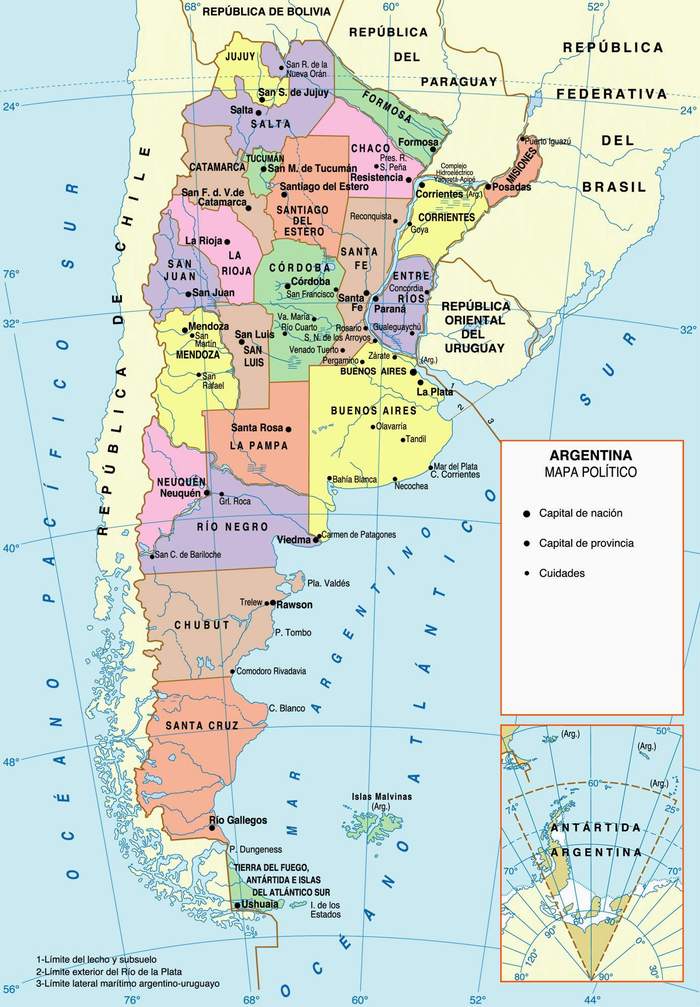
Of course, Argentine history tells us that politicians tend to rattle on about Las Malvinas at carefully chosen moments, (more often than not when there are economic problems or popularity issues) but CFK has long vouched to fight for the islands, which for the general populous here, are absolutely and undoubtedly Argentine. Hey, the local maps of the country with their bracketed ARG next to the islands’ Latin American name say so, the school teachers teach so, and neighbourhoods like Malvinas Argentinas proclaim so. Why would anyone think otherwise?

Venezuelan President Hugo Chavez twittered CFK to give his support. ‘All of the Bolivarian solidarity for you and the beloved Argentine people. Down with colonialism. The Islands are Argentine,’ he wrote.

While a British response to CFK’s outlandish outburst came from a Embassy spokesman in Buenos Aires who spoke to La Nacion newspaper to say, ‘we are a little taken aback because these tests are routine and are carried out every six months. They’ve been happening for twenty-eight years.’

La Nacion also wrote that in an earlier incident last Thursday, according to the British tabloid, The Sun, 'there was a floating stand off when an Argentine warship confronted a Port Stanley vessel, the FV Venturerer, 3.5 miles inside Falklands' waters to falsely accuse it of illegal fishing.'   

The Falklands have caused a tad more fuss than usual as of late, since the UK gave the go ahead for private companies to drill there. Initial tests suggesting there could be around £3 billion ($4.5 billion) of oil in the region.  

Friday, 8 October 2010

Ye Olde Beer House

Got no bricks, no wood, no sandstone deposits lying around the corner! Then smear salty snacks on your tongue and tilt that head back. A few million bottles of beer later and you may just have what you need.  

Quilmes, a city just south of the capital, is the home of Argentina’s best-loved beer, aptly named Quilmes. And it is there that local man Tito Ingenieri has been building his house for the past nineteen years, out of empty beer and wine bottles.

What he has ended up with is quite frankly his own little bottle-topia of a palace, which is not only a house but also a storm forecaster.  

Fortunately for Tito’s health, he hasn’t had to drink the hop and grape filled contents of the six million bottles which have gone into the construction, (I feel a little tipsy just writing about it), but has relied on the ever swelling beer bellies of his neighbours, while also collecting discarded bottles from the streets.

And finding discarded one litre beer bottles in Argentina is no mean feat in itself.

When I was first sent by friends four years ago to pick up beer at the local Chinese supermarket, I took the four empties they gave me, dumped them in the rubbish bin, and then spent ten minutes as the cashier tried to explain why I had to pay more than the displayed price. I forked out the extra and she gave me a ticket. Had the Chinese cashier ripped me off because I was foreigner, I asked my friends. What did you do with the empties they replied. I chucked them away. At which point they proceeded to roll around in hysterics like I was some sort of crazy person.

In Argentina nearly all one litre beer bottles are recycled by returning the empties (known as envases) and exchanging them for filled ones. Finish your bottle, take it the shop, leave it in the crate, and don’t pay the $2.09 extra that they charge for a new bottle. A pretty environmentally friendly practise really. Though it can be slightly irritating when you can’t nip into the supermarket on your way home to pick up a cold one, without first making a detour up to your flat for an empty.

Tito, however, has mainly used the non-returnable variety and in doing so has made a valid contribution to environmental good practice. And though his house might not be everyone’s cup of tea and may attract the odd drunk who comes to lick the bottles, it is certainly an original piece of design and one Tito is proud of.

Who says alcohol is bad. It has certainly aided his creation.

Tuesday, 5 October 2010

You'd have to be crazy to not have a shrink


In a 2005 survey, it was found that Argentina had a mind-boggling 121.2 psychologists per 100,000 inhabitants. That’s one psychologist for every 700 citizens.

This staggeringly high shrink per capita ratio was by far the world’s highest, knocking Denmark into second place with 85 per 100,000 Danes, while the USA, in ninth place, had 31.1 psychologists to cater for the psychological issues of each 100,000 of its citizens.

And the number here continues to rise.

As of 2008, there were 145 psychologists per 100,000 Argentines. While in the city of Buenos Aires the number reached quite out of your mind proportions; a whopping 789 shrinks for every 100,000 porteños, according to a report by Modesto Alonso and Paula Gago.

That’s really teasing poor old Guatemala and Egypt, who rank last with only ten shrinks per one million of their inhabitants.

Psychotherapy was first really introduced to Argentina in the 1940s with the arrival of some rather prominent Jewish psychoanalysts from Austria and Germany. It soon became a dominant element of the culture and by the late 1970s, the last military junta to rule the country began to blame psychologists for the country’s ‘negativity and navel-gazing.’

Military dictatorship cranking out control may have resulted in the disappearance of some better known psychologists but it did not put the brakes on the profession’s expansion and the number of shrinks catering for the psycho-babble needs of the people, rose and rose from 5,500 in 1974 to 37,000 in 1998, and has now arrived at over 57,000.

In modern day Argentina, mental health is covered by nearly all social welfare services, and going to sit down, or lie down, or stand up and walk around in circles with your shrink is as normal as hitting the gym, or going to the doctor when you feel under the weather. There may be as many psychology clinics on a typical block as there are kiosks selling sweet, alternative therapy-chocolate covered alfajores.

Why the obsession?

Although there have been no anthropological or sociological studies to identify why the interest in psychology is so paramount in Argentina, some experts suggest it is due to a society frustrated by an ever present failure to meet expectations, and a mentality dominated by the idea of the next economic/political crisis.

While others maintain that is has nothing to with a neurosis about the country’s problems, but more a simple interest amongst Argentines to know themselves better in an ever increasingly challenging world.

But for whatever reason, be it for a ball-swelling boss, or a I’m stuck in I wanna rub my temples with sandpaper relationship, Argentines do take comfort in chatting it through with one of the country’s thousands of mental health pros, and tend to have no qualms about talking openly about their shrink visiting escapades.

So, while in other less psychoanalytically developed societies, people may think of you as a little loco to have a shrink, in Argentina the only real stigma attached to it all, is if you don’t have one.

Friday, 1 October 2010

Argentina leads the way in defending President Correa

“For as long as I'm president, Argentina will never recognize a government that is not the result of a popular vote," stated President Cristina Fernández de Kirchner as she and her hubby, UNASUR Secretary-General Nestor Kirchner, hosted an emergency summit of South American presidents in Buenos Aires late last night.

"Argentina has a history of coups branded on its DNA, so we’re not just going to allow one to take place in Ecuador," she said as she stood in for Rafael Correa, the pro tempure UNASUR president.

Venezuelan head of state President Hugo Chavez praised CFK's hubby for such a quick reaction in light of the attacks on President Rafael Correa in Quito.

While Argentine Ambassador to the United Nations, Jorge Argüello, stated that he considers Argentina ‘to once again be occupying a relevant and historic position among nations,’ clearly hoping that this act demonstrates why Argentina requested to be granted a seat on the United Nations Security Council in 2013.


Tuesday, 28 September 2010

Strictly Come Stripping - The lows of the lowest of popular entertainment

No Brucey with his charismatic Forsyth charm introducing bow-tied gents and elegant, self respecting ladies to come and dance a graceful ballroom routine. No Len Goodman sharing an innocent joke with his little Italian sidekick as they judge contestants on their footwork and posture.

This is Canal 13's Bailando por un sueño (Dancing for a dream) and no one gives a toss about footwork.

If you want high scores here, then girls, get off your kit, flash a little leg, some cleavage, maybe even bend over and bare and bounce your blemish free butt cheeks, neatly separated by the G-ist of G strings, as the cameraman zooms in close enough to check all your most intimate details. Then proceed to take off what little is left and strut your stuff to Regaetton, Salsa and Hip-Hop as you emulate sex while riding your partner in positions straight out of the Karma-Sutra. What about the Argentine Tango some may ask. Don’t be silly, that would actually require wearing clothes, not to mention a dedication to dance.

One should of course, be excused for thinking that Dancing for a dream has anything to do with dance. People do dance but that’s not why people watch.

The brainchild of Marcelo Tinelli (Argentina’s most powerful television star, pictured left), and his Ideas del Sur production company, Showmatch: Bailando por un sueño, is all about personal scandals and arguments amongst contestants and judges. That’s what gets ratings. The dancing really doesn’t matter.

The show, in its sixth season, generally lasts from April until November/December. It airs nearly every weekday night and is analysed all day long by nigh on every other programme on every other channel.

Contestants talk openly about who’s screwing whom and who’s fighting with whom, while the five judges bicker like children and storm off when things get really out of control. (More often than not to head to Miami on holiday).

So far this year, the host Marcelo Tinneli has been serenaded by prospective future girlfriends, judges have secretly filmed one another on mobile phones and then splattered the media with the images. There have been the standard fall outs and constant name calling; and though thirty minute slanging matches are the norm, things did get interesting when seventy-six year old contestant Sarah Paddy Jones from the West Midlands in the UK took on Multi-millionaire heir to The Chocalates Felfort empire, judge Ricardo Fort when he slammed her partner’s performance, and hurled personal insults back and forwards.

The show has been accused of being pornographic and its ten-thirty p.m. broadcast time inappropriate in a country where young children are typically up past eleven. But it does appear that most of the female contestants, who are by and large celebrities for being celebrities, are willing to slut themselves up for media exposure. In some ways perhaps it is not so different to certain reality shows in other parts of the world.

But in a country absolutely obsessed with celebrity gossip and scandal, Bailando por un sueño continues to be the highest rated show, dominating television here. And these so-called celebrities know that tonguing their partner or rolling around on the floor with their feet up behind their head, will keep their image on the screens for fifteen seconds longer.

No Brucey, but then again, it is not for witty comments and cheesy humour that viewers tune in to Bailando por un sueño.